Three numbers from last month’s call log decide your AI receptionist bill far more than the price in big type on a pricing page: how many calls you got, how long they lasted on average, and how many different people made them. This page shows how to get those numbers, a worksheet that turns them into a monthly cost for any service, and real rates from nine services so you can see where each billing model wins.
All prices are US dollars, monthly billing, read from each vendor’s own pricing or help page on November 29, 2026. For what these services do beyond the price, see our guide to AI receptionists for small business.
The short answer
- Short calls favor per-minute plans; long calls favor per-call plans. Divide a per-call price by a per-minute price to get the call length where they cost the same.
- Lots of repeat callers favor per-caller billing. Goodcall counts each phone number once a month.
- The sticker price leaves things out: the phone or software plan an add-on needs, rounding, what happens at your limit, and which calls aren’t billed.
- At 150 calls a month of 2.5 minutes each, the cheapest fitting plan at each of the nine services we priced ranged from $100.50 to $270 a month.
Step 1: Get your three numbers
 Graphic by The Practical Bot (own work).
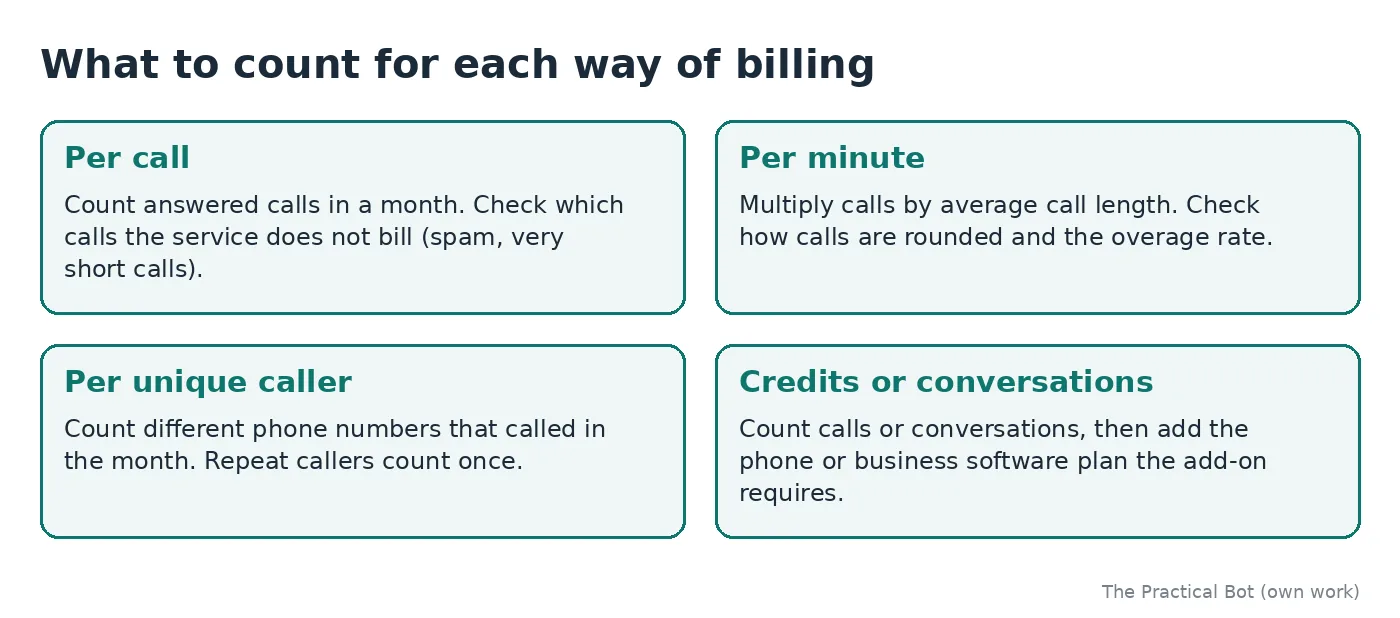
- Calls per month. Count incoming calls for a recent, normal month from your phone’s call history or your provider’s online account. If you only want the AI to take calls you miss, count only missed and after-hours calls.
- Average call length. Total talk minutes divided by calls. If your log doesn’t show minutes, time ten typical calls this week. Calls to an AI receptionist may run a little longer than your own, because it asks for name, number and address every time, so round up.
- Different callers. Count unique numbers. This only matters for per-caller billing, but repeat callers (customers chasing a quote, people calling back after a missed call) can make a big difference there.
Step 2: The worksheet
Fill in one block for each service you’re considering. “Included” and “overage rate” come from the plan’s pricing page.
| Billing model | Formula | Your numbers |
|---|---|---|
| Per call | plan price + (calls − included calls) × overage per call | |
| Per minute | plan price + (calls × average minutes − included minutes) × overage per minute | |
| Per unique caller | plan price + (different callers − included callers) × overage per caller | |
| Credits or conversations | base phone or software plan + add-on tier + (calls − included) × overage |
Two rules make the result honest:
- If the overage part comes out negative, it’s zero. You don’t get money back for unused calls or minutes.
- Price the next tier up too. At some volumes the bigger plan is cheaper than the smaller plan plus overage. Upfirst at 100 calls is an example: Starter would be $24.95 + 70 × $1.50 = $129.95, while Premium is $59.95 + 10 × $1.00 = $69.95 (Upfirst pricing).
Step 3: Compare rates on equal terms
Pricing pages list plans by included usage, which hides the real unit price. This table divides each plan’s price by its allowance, then turns per-minute rates into a cost per call at two call lengths. These are best-case numbers: they assume you use the whole allowance.
| Service and plan | Price | Included | Per unit | Per call at 2.5 min | Per call at 5 min |
|---|---|---|---|---|---|
| Upfirst Premium | $59.95 | 90 calls | $0.67 a call | $0.67 | $0.67 |
| Upfirst Pro | $159.95 | 300 calls | $0.53 a call | $0.53 | $0.53 |
| Smith.ai Pro | $270 | 150 calls | $1.80 a call | $1.80 | $1.80 |
| Goodcall Starter | $79 | 100 callers | $0.79 a caller | $0.79 or less | $0.79 or less |
| Goodcall Growth | $129 | 500 callers | $0.26 a caller | $0.26 or less | $0.26 or less |
| Rosie Professional | $49 | 250 min | $0.20 a minute | $0.49 | $0.98 |
| Rosie Scale | $149 | 1,000 min | $0.15 a minute | $0.37 | $0.75 |
| RingCentral standalone | $49 | 100 min | $0.49 a minute | $1.23 | $2.45 |
| Dialzara Pro | $99 | 220 min | $0.45 a minute | $1.13 | $2.25 |
| My AI Front Desk | $99 | 200 min + $10 credits (40 min) | $0.41 a minute | $1.03 | $2.06 |
| Quo Sona $49 tier | $49 + Quo plan | about 100 calls | $0.49 a call | $0.49 | $0.49 |
| Jobber Receptionist | $99 + Jobber plan | 100 conversations | $0.99 a conversation | $0.99 | $0.99 |
Goodcall shows “or less” because a caller who rings three times is billed once. Rosie’s per-unit cost is low, but its pricing page doesn’t show an overage rate, so price the plan that covers your whole month.
Break-even call length
Per-call price ÷ per-minute price = the call length where both cost the same. Using rates from the table:
| Per-call option | Per-minute option | Same cost at |
|---|---|---|
| Upfirst Premium extra call, $1.00 | RingCentral overage, $0.50 a minute | 2 minutes |
| Smith.ai Pro 150, $1.80 a call | Dialzara Pro, $0.45 a minute | 4 minutes |
| Upfirst Pro, $0.53 a call | Rosie Scale, $0.15 a minute | About 3.5 minutes |
If your calls run longer than the “same cost” length, the per-call option is cheaper. Rounding pushes the real break-even lower for per-minute plans: RingCentral rounds each call up in 30-second steps, so a 2 minute 10 second call is billed as 2.5 minutes (RingCentral pricing).
Step 4: Watch how one business’s bill moves
One made-up business, 150 calls a month, priced on the cheapest fitting plan at each service (overage included). Only the inputs change between columns. Real prices, invented business.
| Service | A: 2.5 min calls, 150 different callers | B: 5 min calls, 150 different callers | C: 2.5 min calls, 90 different callers |
|---|---|---|---|
| Upfirst | $119.95 (Premium, 90 + 60 at $1.00) | $119.95 | $119.95 |
| Smith.ai | $270 (Pro 150) | $270 | $270 |
| Goodcall | $118.50 (Starter, 100 + 50 at $0.79) | $118.50 | $79 (Starter) |
| Rosie | $149 (Scale, 375 min) | $149 (Scale, 750 min) | $149 |
| RingCentral standalone | $186.50 (100 + 275 min at $0.50) | $374 (100 + 650 min) | $186.50 |
| Dialzara | $168.75 (Pro, 220 + 155 min at $0.45) | $299 (Plus, $199 + 250 min at $0.40) | $168.75 |
| My AI Front Desk | $132.75 (240 + 135 min at $0.25) | $226.50 (240 + 510 min) | $132.75 |
| Quo Sona + Quo Starter ($19) | $100.50 ($49 tier, 100 + 50 at $0.65) | $100.50 | $100.50 |
| Jobber add-on (plus your Jobber plan) | $138.50 (100 + 50 at $0.79) | $138.50 | $138.50 |
What changed:
- Doubling call length roughly doubled the overage on RingCentral and My AI Front Desk and pushed Dialzara up a tier. Per-call and per-caller prices didn’t move.
- Repeat callers (column C) dropped Goodcall from $118.50 to $79, because 90 different numbers fit inside its 100-caller Starter plan.
- Features aren’t priced in. Rosie’s $49 plan only sends booking links, and calendar booking starts on Scale (Rosie pricing). Dialzara’s cheapest plan has blind transfers only (Dialzara pricing). Price the plan with the features you need, not just the cheapest one.
Costs the pricing page doesn’t add up for you
| Cost | Example |
|---|---|
| The plan an add-on needs | Quo’s Sona needs a paid Quo plan, from $19 a user on Starter; call transfers are listed on Business at $33 a user (Quo pricing). Jobber’s $99 add-on (100 conversations) sits on top of Core, Connect or Grow; Receptionist is included with unlimited conversations on Jobber Plus (Jobber help). |
| Extra agents or lines | Upfirst charges $9.95 a month for each extra agent (pricing). |
| Rounding | RingCentral bills overage in 30-second steps, rounded up. |
| What happens at the limit | Quo’s Sona overages are off by default, so calls go to your fallback (usually voicemail) when credits run out (Quo help). Jobber lets you choose to pay overages or pause (Jobber help). Others simply bill more. |
| Notice periods | Smith.ai is month to month but asks for 30 days’ notice to cancel (pricing). |
| Your time | Reading summaries and fixing answers. Budget an hour or two a week in the first month. |
And some savings worth knowing about. Upfirst doesn’t bill spam, calls under 15 seconds, or calls where the caller never speaks (pricing). Quo uses no credits for Sona calls under 15 seconds. Smith.ai filters known spam numbers and lets you remove up to 10% of calls from your bill as spam (pricing). If a lot of your calls are robocalls, these rules can matter more than the headline rate.
Is the cost worth it?
That’s a separate question from which plan is cheapest. Take the monthly figure from your worksheet, add your review time, and divide by your profit per job: that’s how many extra jobs a month it has to win. Our guide Do you need an AI receptionist? walks through that with three example businesses. Once you’ve picked a plan, use the test-call checklist during the trial, and set it up to take only missed calls with our call forwarding guide.
FAQ
How much does an AI receptionist cost per month? Among the nine services we priced, entry plans ran from free (Smith.ai’s 25-call plan, $3.00 per extra call) to $99 a month. For a business taking 150 calls a month of about 2.5 minutes, the cheapest fitting plan at each service came to between $100.50 and $270.
Is per-minute or per-call pricing cheaper? It depends on call length. Divide the per-call price by the per-minute price; if your average call is longer than that many minutes, per-call is cheaper.
Do spam calls count? It varies. Upfirst and Quo don’t bill very short calls, Goodcall doesn’t count spam or wrong numbers, and Smith.ai filters known spam numbers and lets you remove up to 10% as spam. Check the FAQ for any service you shortlist.
Is annual billing worth it? Several services discount annual plans (Upfirst’s Starter drops from $24.95 to $20 a month billed annually). Pay monthly until a trial and a month or two of real calls show the service works for you.
Why doesn’t this include every AI receptionist? We only priced services whose prices, allowances and overage rates we could read on their own pages on the check date. Rosie is included without an overage rate because its page doesn’t show one.